
“Curiosity Vs. Interest in determining Media Literacy Levels“
Acknowledgements
With all the hard work, courage, commitment to learn, sacrifices and long nights and days put into finishing this research I would like to first and foremost Thank Wholeheartedly The Almighty الله for giving me the power and mental strength to sea through all my academic endeavors to the deadlines and beyond. Thanks to Professor Mohammad Sham who is continuously being the source for guidance and encouragement towards pushing my mind to its outmost best capacities. Special Thanks to My Parents who stood by me through the thick and thin not least of course All other Instructors with special Thanks To All who shared their best insights in The amazing journey of My education…..
Abstract
Media Literacy is a demanding Area of Study for analysis of Target audience reactions, trends of use and service demands of the new age of industry and Technology, which collectively depend on the Outreach through media Channels and Outlets. There are always two aspects with which research on this field is initiated, the Curiosity of the audience towards engagement in media interaction and the continuous Interest in the follow up and freedom of opinion. There isn`t a simple one-step approach that can conclude how well the public is engaged in the interaction and there aren’t any predetermined statistics to facilitate interpretations of Media consumption levels Beforehand. Careful consideration of Demographic and Geographic findings through research are needed to reach specifically demanded Media consumption data, with the help of evaluation and credible profiling, audience analysis would help organizations set forth standards and better edit policies to foster favorable results through Media outlets.
TABLE OF CONTENTS
- RESEARCH OBJECTIVES
- Problem Statement
- Important Definitions & Contrasts
- Research Questions
- INTRODUCTION
- LITERATURE REVIEW
- Media and its types
- Media literacy in general
- Mainstream media vs. Social media
- Pros. & Cons. In Mainstream media literacy
- Pros. & Cons. In Social media literacy
- METHODOLOGY AND DEFINITIONS & CONTRASTS
- BODY
- Formulating curiosity towards Mainstream media
- Formulating curiosity towards Social media (this one being more compulsive)
- Why compulsive? (Social Media)
- How does curiosity form itself? Is interest related? A Psychological point of view.
- How does interest appeal to curiosity? What is the difference between the two?
- Self-Determination Theory in Brief.
- Resisting the temptation of curiosity for knowledge (Related to selective perception)
- Selective Perception, Media Consumption and Media Literacy.
- CONCLUSIONS AND REVIEWS
- LIST OF REFERENCES
- APPENDIX A: Interview Subjects
- APPENDIX B: Figures
- INTERVIEW QUESTIONS
- RESEARCH OBJECTIVES
1. Problem statement
Understanding media in general and specifically the media content itself has proven to be such a challenging and rather presumptuous matter where any opinion or point of view may be considered as a fact and believed with or without the credibility factor. Being literate doesn`t necessarily mean the ability to deduct the real understanding or perception of information through media but is just a facilitation for the proper perception.
My research on curiosity vs interest in determining media literacy levels is aimed at understanding how literacy levels in understanding media in general can be established.
It is a comparative approach to a conclusion on which has more effect and more influence in determining the literacy needed to fully understand and perceive media content, is it curiosity which determines literacy levels in media or curiosity has the upper hand?
2. Important definitions and contrasts in the research
In order to reach a specific and focused objective in this research, the definitions of both curiosity and interest that relate to media literacy will be clarified clearly and their irrelevant corresponding meanings will be identified to further focus on the main objective of the research. Accordingly, what the term media literacy levels actually means and how it effects the perception of one`s ability to interpret information in media generally, would be the definitive factor to determine how this research formulates a logical understanding of the basis for comparison between the two terms “curiosity” and “interest”.
3. Research questions to be investigated throughout this research
- What are the different methods used in determining media literacy levels? Which ones can relate to both curiosity and interest?
- Can the literacy level of a person be considered as numerical value?
- What is the proper definition of curiosity and how does it contribute to the levels of media literacy?
- What is the proper definition of interest and how does it contribute to the change in literacy levels of any person?
- How can the determined literacy levels be adjusted to be functionally effective?
- Introduction
The media environment is in a constant change in content, strategies used, transmission methods and technologies used as well. It is quite important for the typical media content follower to understand how these different tactics are used in order to send information through media to the audience, having the right knowledge would insure a better perspective on how to react accordingly to whatever appeals to the receiver. In the current age of technological and industrial advancement media is being considered as the main viewpoint for the public to interact with any business whatsoever, whether it`s private or governmental, media has a direct and effective impact on the performance and evaluation of all services targeting the mass majority of people. The term media literacy which refers to how well the public reacts to information through media is always considered when any organization or business formulates a strategy to accomplish their outreach to the public. This technique itself is considered as the main factor for all the operation policies of organizations and businesses for their employees to follow.
In order to initiate any informative approach to a larger public through media, the organization or business starts by trying to properly understand the public behavior and how their reactions towards content in media can benefit the organization in a way that creates positive recognition of its services aimed for public use. Any approach taken should consider certain factors taken from a proper research on public attitudes and behaviors in certain relative situations. (Webster, 1997) An example can be how surveys are used after certain services are supplied to the public which ask specific questions about technicalities of products or in many cases the attitudes and actions of employees during service. These surveys help the organizations in evaluation of products, service methods and a constructive implementation of their internal policies to better enhance their image towards their customer base.
Then there is the part of media which is mainstream that transmits news and information about events and happenings in the social environments of which the public follow and interact with to stay connected to their environments. Throughout this research the focus isn`t just on one aspect of media where the impact on the interests of the public may seem more alternating between negative and positive ideologies on the outreach mechanism of the entities that deal with power and/or money, it is rather an investigation onto how the public intervene in the formulation of their attitudes towards information through media in general and their level of understanding of how to differentiate between facts and opinions, right and wrong, appropriate or inappropriate which is a main verdict in evaluating the information transmitted through media.
- Literature review
1. Media and its types
Media is a term used to describe all the mediums of communication to larger audiences and the technologies and techniques used in these mediums is dependent on the function of the information transmitted. There is the mainstream media which refers to the organizations and entities that transmit news to a larger public through television, radio and newspapers mainly reflecting and shaping the prevailing currents of thought within our existing environment depending on the effective social changes within our surroundings. Mainstream media mainly chooses its content according to the public`s collective trend in thoughts, behaviors, actions, reactions and knowledge as well. The evolution of mainstream media has come about in the shape of a different but more advanced diverse configuration making the outreach to the public more concentrated and classified at the same time, forcing the content to be automatically adjusted purposefully in order to provide a better sense and differentiate easily between information and content (Forde, Oct 2012, Vol. 18 Issue 2). Still the decision of what`s relevant and what`s not comes in the hand of the receiver of this content and how to percept and analyze for an understanding is sole proprietorship of the regular person. The advancement to the alternation from mainstream media to social media as a commodity to the progressive need to reach the public through the fastest and simplest route to acquire their attention towards any content wasn`t just a simple transition to a modern way of mass communication, it has become a mainstream itself for all forms of social engagement in many businesses and organizations to associate with their usual functioning communication mediums.
2. Media literacy in general
For the usual receiver to stay connected with the continuous feed of information through different channels within mainstream or social media there is a hypothetical level of understanding and knowledge which is considered as a default for acknowledging content and information. This is defined as media literacy and is a term used to describe how the receiver can transform any transmitted information or content into a feasible and beneficial level of knowledge (Potter, Nov 21, 2013). The technology through which social media operates is in a constant change and innovation which quite serves one purpose which is to reach more public and larger audiences and form a huge network through which information can freely interact with minds.
A researcher in Nahtam Social Responsibility in AbuDhabi, UAE had the following to say when asked about media literacy:
“For centuries, literacy has referred to the ability to read and write. And Media literacy is the ability to access, analyze, evaluate, and create media. Many educators have discovered that media literacy is an effective and engaging way to apply critical thinking skills to a wide range of issues. But the most basic literacy skills to understand media would be:
- Awareness of the impact of media.
- Understanding of the process of mass communication in context of media.
- Ability to think critically about media messages, no matter how credible the sources are.
- The ability to express the content in the simplest form of language which is understandable for a lay man as well.”
3. Mainstream Media vs. Social Media
For the ordinary person the mainstream media is mainly seen as a reflection of the events happening around you in the social environment whether it`s political, educational, health, entertainment etc. the media operates on the context of letting the larger public know what`s happening around them. This is true to some extent only when you start to differentiate between the classifications of the content and information yet deciding on what appeals to you of course depending on the attention and focus reflecting your area of interest. The main challenge for mainstream media is that it doesn`t classify its content according to the compositions of the public, mainly age and educational level both and together are considered the main decisive factors to evaluate the relevance of what the media transmits. These two factors are what social media properly moderated in an effective way that contributed to how better the public outreach has become through social media, making it stand out and subside the need for mainstream mediated content even though the latter it is superior somehow. On another level social media has proven its supremacy in creating an audience base much larger than that of mainstream through entertainment and info mobility, appealing to both curiosity and interest of the public in an irresistible manner that exceeded that of mainstream media. (vicenzo marino, 2015)
4. Pros and cons in mainstream media literacy
Mainstream media has established itself to be the source for new and much needed information and content for the public since its start mainly because journalism is involved where there are people who collect and follow up on events and occurrences that appeal to the public in all aspects. Journalists are the ones challenged with the decision making of which content can be used for the public or not, yet there is a slight tweak made by their superiors who are in the form of stakeholders to the media company itself that hold the key decisions in this matter. Profit and views are what matter most in the media industry nowadays in a world driven by public opinion it is important to keep the public`s stand-by attention in order to not lose views and followers. Another perspective would be how the mainstream media sometimes works through agendas and plans set up by their linear governments or business entities which are sort of entitled to the divided ownership state which depicts them. (Newman, 2009) There are many examples of this happening in many countless media organizations worldwide where the apparent clues leading to such assumption are quite often portrayed and referred to by evidence. However, a considerable percentage of the public audience does not actually have the required literacy levels to achieve such understanding and this is a disadvantage itself for the mainstream caused by the mainstream mediums. If that is understanding is achieved then there is the question of how well this literacy of a person can drive them towards credible perceptions of the mediated content and share their knowledge within their social circles.
5. Pros and cons in social media literacy
So mainstream media has hooked its outreach through social media in order to reach larger audiences and appeal to the audience accordingly. The effect that social media outreach has on getting audience attention is far more advanced than that of mainstream media in the sense that all content is categorized and classified according to tastes, behaviors, age, interests , appeals, etc. There is a credible understanding that social media itself has become addictive in the nature of its connection with the public audience, where the uncontrolled use for seeking information, connectivity and entertainment altogether has been used as a commodity to target audience attention and follow up with the trends and changes within. (www.ofcom.org.uk, 2016)
- Methodology
The basis for any approach towards an evaluation of the effects of curiosity or interest in determining any media literacy levels within the context of this research is dependent on comparisons and contrasts to be pointed thoroughly from interviewing some experts in the field of media and behavioral psychology. The information collected within would mainly be from collective qualitative information from different researches and reports on media literacy, the main focus would be on the terms curiosity and interest and whether any of them is more affective in determining media literacy levels of individual audiences and receivers of media content. However, in order to start out with the right criteria for analysis it is important to start by defining the research objective specifically the definitions of the terms used in this research to have an in depth understanding of the purpose behind this study.
- Definitions and Contrasts
Let me start by defining the research statement here “Curiosity vs Interest in Determining Media literacy levels” where the two terms here Curiosity and Interest are two different words with different meaning. Although they might seem the same at first thought but they have quite a different implication within the phrase “media literacy levels”. Curiosity is a term used to describe the strong desire to learn or know something (oxford), it is the noun for the word curious which means the eagerness to know or learn something (oxford, https://en.oxforddictionaries.com/definition/curious). Curiosity does define in meaning how audiences interact within media as it is probably the main focal point for the attention and follow up from a person`s point of view. The main aim for any research on audiences from media specialists seems to give much care as to how curious people can become towards any new content and the creativity and attractiveness of the content is what sparks this curiosity. Then there is interest which means the feeling of wanting to know or learn about something, it also the quality of exciting curiosity or holding the attention (oxford, https://en.oxforddictionaries.com/definition/interest). Now both words seem to have the same context of meaning but let`s see what are the differences in meaning between both within language use. Accordingly, they are being differentiated in the order of their existence in the regular person where curiosity comes first in the seeking for information that is unknown because it is a stimulated reaction by the mind that happens unconsciously, according to psychological researcher Suzanna Hidi curiosity works only when the person is unaware of the knowledge gap between knowing and not knowing a certain piece of information such that interest is the continuous search for what determines that knowledge gap (Hidi, 2016). The difference between curiosity and interest can clearly be determined by the active conscious commitment of a person in seeking knowledge from any content that has been existent but undiscovered yet by the person. Another understanding is that curiosity is an act of eagerness to know more information based on an existing short-term evaluation made by our minds of the possibility of progressing to that information retrieval status where the information would mean something to us and add to our comprehension of the topic in question. On the other hand, interest is an already existing desire within our minds that is driven by the need to add more to the existing former knowledge we have about any topic such that we achieve a sense of relief after finding what we are looking for. Now Media literacy is a term that generally refers to how well individuals perceive any content in an effective way to reach the skill set needed to understand the purpose and function of any random information or content within the media outlets and become able to react towards it in an intellectually stimulated or driven manner while sharing that knowledge with fellow audiences either controllably or automatically. (Livingstone, 2004) The level of knowledge resulting from this active interaction is what is referred to here by the phrase “media literacy levels” such that the audience reaches the potential capability needed towards a credible and well maintained level of understanding appealing to the majority of the public already interacting within their default knowledge gap standard.
I interviewed a Researcher in Nahtam Social Advertising in AbuDhabi UAE and asked if curiosity and interest are the same and how to differentiate between them, he said:
“For me, curiosity and interest isn’t the same. Curiosity is all about a desire to know about anything. And interest, is all about the willingness of paying attention to anything.”
“A media person can create curiosity well among the people. It depends on how well the content is wrapped. However, in terms of interest, the interested audience already has a base about a specific subject and the media content should be more scientific along with the essence of reality. In both the cases, a genuine media will only help the media literacy of a person.”
- Body
1. Formulating Curiosity towards Mainstream Media.
Mainstream media had been and still is to some extent the main source and provider for updated news, information and content to the public through journalism and all its peripheral functions of pursuing credible information in all aspects of our social environment. The first audience who interact with this information are the ones who tend to spread it through to other communication mediums and mainly through social media platforms, but the main question here is how do these first receivers of the information come to realize the importance or commodity of their reflections from mainstream content? Well this is the systematic mechanism which media literacy depends on in reaching out to interested audiences, here`s how this happens. The first receivers of the content are the ones who have already taken interest in following the updates from mainstream media; they are continuously engaged in the interaction with mainstream, and that allows them to exercise their interest by becoming curious of the new content or information retrieved that is relevant to their social environment. The process of how they share their perceptions with others is coming from pure interest which is formulated either from their professional status or their knowledge-rich social network of people. For any group of people sharing the same interest they automatically trigger their curiosity towards what might be new in the media outlets to further enrich the knowledge and understanding within their intended network. A report by Nic Newman had explained how the mainstream media is no longer having the dependence from the public like it was before the rise of alternative forms mainly social media (Newman, Mainstream media and the distribution of news in the age of social discovery, 2011). An interesting quote in Newman`s report taken from the book ‘We the media’ by the author Dan Gillmor:
“Big Media has lost its monopoly of the news. Now that it is possible to publish in real time to a worldwide audience, new breeds of grassroots journalists are taking the news into their own hands”.
Furthermore, Newman described how Citizen Journalism and social media had either started replacing or setting aside the importance of journalism and that the sources for the news and the transmission outlets are overcoming the need to follow mainstream exclusively.
2. Formulating curiosity towards social media (this one being more compulsive).
Comparing the outreach of mainstream media with that of social media according to several factors stated above, makes the argument in favor of social media and how it exceeds mainstream`s functional methodology in targeting audiences. As such, the flowing freedom of information through social media networks does in fact consider the different preferences of the public and especially in terms of media literacy and the ability to perceive the content both conveniently and effortlessly. The regular users of social media platforms don’t all follow the same interests, but with the diverse mediated trajectory portrayed by the selectivity of social media platforms in creating the content, the curiosity aspect is broadened and the knowledge gap can be improved easily. The focus and attention of the users can seem to be automated and driven by a characteristic that is formed from both amusement and gratification, but how does this occur? A research study conducted by Kantar Millward Brown investigated the curiosity associated with technology use by the public which is driven by the accessibility and pervasive nature of smartphones, apps and mobile technology (Kantar MillwardBrown, 2016). According to the public behaviors driven by the curiosity nature four archetypes were identified which are the Answer Seekers, Focused Shoppers, Explorers and Careful Buyers. These are not specifically all happening for one person but differ according to the categories of interests, mindsets and behaviors which are all driven by the degree of curiosity and mainly also by the urgency of their actions.
Their findings from a survey across six international markets USA, UK, India, China, Turkey and Brazil came up with following conclusions on what Triggers their curiosity:
- Curiosity is triggered in USA and UK similarly by random thought which develops from conversations with friends, relatives or acquaintances while in UK it is much more of searching internet through laptops.
- In India people seem a lot more thorough in their searches and tend to research online images or videos.
- People in China trigger their curiosity by things they read either a catchy headline or an article or even offline.
- People in Brazil are more likely to be triggered by physical objects.
- In Developing countries traditional media seems more influential in the decision-making of people rather than online media although the latter is much widespread.
Curiosity and its effect on people and how they act upon the urge of research and gratification differ in the demographic categories or age and gender. It was stated in the research findings that women are 50 % more likely to be triggered by physical objects or images whereas men are more likely to pursue their search online using different methods to acquire information.
Across the different markets the age factor determining curiosity levels and behaviors showed differences which vary from one age group to another. It was noticed that at the age group of 25-35 people were more curious about relationships where many start to settle down at that age and it starts to drop as they get older. Less than 25 age group tend to use smartphones for video browsing where above 50s are less likely to do so. Attention spans differ in age groups leading to peaks in curiosity pursuit through searching and browsing with the younger less likely to stop their search depending on what their findings are or their perseverance at the time. Over 50s are less motivated on searching out of their targeted or intended topics on the contrary to younger ones who can rather browse different topics before stopping or calling of their search.
3. Why compulsive? (Social Media)
From the above findings, a credible understanding is established on how curiosity towards social media can formulate and then, decimate gradually rather than disappear. But what makes it compulsive in nature and irresistible to undo or act upon, it is that urge to stay connected and updated with all that there is through social media platforms mainly and most certainly through the entertainment aspect. The fun factor associated with entertainment through gaming, movies, social networking, music, info mobility etc. where the users can choose to be in continuous reach for such services and features with the reach of a thumb. Curiosity here acts unconsciously and at many times disregarding time and other things while preferring the company of their smartphones or laptops uncontrollably and compulsively. This can be more described as under the influence of curiosity using the tools in this case technology and more specifically smartphones.
4. How does curiosity form itself? Is interest related? A psychological point of view.
The human mind is created with the nature of looking constantly for answers to questions on facts, topics, events, objects etc. and the enquiry nature of humans stimulates their interests to pursue knowledge that is vital for survival both socially and personally. A quote from Elizabeth Gilbert author of “Big Magic: Creative Living beyond Fear” describing the curious nature of humans as an alternative to passion (Gilbert, 2015), she said:
“Following our curiosity instead of our passion is the real key to an interesting and creative life.”
It is of basic instinct that curiosity is formed in us from our childhood years where we start discovering the world around us through questioning the nature of things and how they come about to existence. We don`t actually realize the impact of the excitement we get from exploring in our early years until we get to an age where we can analyze whatever findings we come up with and evaluate according to facts we learn through our education or our parents and even our social environments. And so, as we get older we start to search for simpler ways of making sense of our lives through certainty and security which gives us the vantage in our pursuit of knowledge for survival.
In an article about the power of curiosity (Kashdan, 2010), happiness was portrayed as the main targeted endeavor for most people according to a survey conducted in 2007 by the Association for Psychological Science, other aspects of life goals such as success, wisdom and wealth were viewed as less important than happiness. Well, according to psychologists the best way to acquire happiness is to cultivate our sense of curiosity which because this active interest in knowledge creates the groundwork to feel and experience discovery, joy and delight. There are five benefits of an inquiring mind where our curiosity enhances our quality of life and well-being:
- Health
Psychology researchers who conducted studies that relate curiosity to health improvement had investigated findings that suggest a positive connection deserving further study.
- Intelligence
Several studies by psychologists have shown that high curiosity levels are connected to greater analytical, problem-solving and intelligence abilities.
- Social relationships
Curiosity creates an active interaction state with which the person influences a positive relationship with people that is seen as interesting and beneficiary to both.
- Happiness
A survey conducted by The Gallup Organization with more than 130,000 people from over 130 nations, identified two factors of enjoyment for people “being able to count on someone for help” and “learned something yesterday” which both are foundational components of a happy life and are both supported by curiosity.
- Meaning
Curiosity indeed is found to be the main entry point to all life`s greatest gratification and satisfaction which is formed from the pursuit of interests hobbies and passions.
5. How does interest appeal to curiosity? And what is the difference between the two?
The following figure shows how interest research is approached and all possible focal points:

As interest was defined to be the active pursuit of information and knowledge, it is derived from the attention of the audience resulting from their involvement closely with either a profession or an already existing desire within them for knowledge. As psychologist researcher Suzanna Hidi stated that the active conscious commitment appeals more to the interest of the person than that of the curiosity, which in turn drives the person to continue searching and looking for any information that is required to close the knowledge gap that determines how much a person knows and perceives (Hidi, 2016).
When defining the role of interest in the learning and development of the mind there is one important factor that is being pointed out by psychologists researching on the topic, it is the relationship of interest to the motivation of behavior. Psychologists, Deci, Eghrari, Patrick and Leon conducted an experiment in 1991 making subjects work on a boring activity although it was an activity used for the improvement of concentration, upon studying their findings they concluded three factors important for determining the importance of the activity in self- regulation for a person (K Ann Renninger, 2014):
- -providing a rationale for the dull task in the sense that it can improve concentration.
- -Minimizing and easing the pressure to provide and insure a sense of choice and commitment for the task in hand.
- -Acknowledgment that the subjects might find the activity uninteresting.
Accordingly, this concluded to them that when people are willing to participate and engage in uninteresting activities it is their evaluation of the importance and instrumental value of the activity for their benefit. This would result in the internalization of regulation fostered by the social contexts that are characterized by the active involvement and autonomy support of the task. This in turn leads to the gradual change in attitude towards the task, making it more interesting through internalization and integration.
6. Self-determination Theory in brief(K Ann Renninger, 2014, p. 44):
It is a theory of motivation that distinguishes the motivation dynamics elemental to the activities that people choose to engage in freely or are somehow coerced or pressured to do. Self-determining refers to the engagement in an activity with a full sense of wanting, choosing and personal endorsement; people are acting independently and desirably. As a concept, self-determination describes the formulation of behaviors supported by what Psychologists call “the integrated self”
To understand the difference between interest and curiosity it is first better to determine which one comes first in the learning and development process, curiosity comes to the person first as a surprise in the sense that it intrigues the mind and stimulates the urge for further knowledge. When a person is met with any information or fact that makes them question it further in order to increase the understanding of it; their curiosity starts acting and pushes the mind to start searching for relevant information either through conversation, reading, internet search. Upon establishing the state of mind where the engagement becomes active and continuous then interest starts to formulate and take over from curiosity but not in a complete manner, where they both start acting each one at a time in stimulating the person`s desire towards active engagement in the search for information.
7. Resisting the temptation of curiosity for knowledge. (related to selective perception)
The presence of a very strong relationship between curiosity and the development and learning process cannot be denied. Factually from many studies and researches by psychologists and cognitive development specialists, before media professionals, had already concluded and proven how in order to achieve the continuous interest in the search for knowledge people should exercise their curiosity and motivation of behavior for learning mainly under the context of the self-determination theory which is vast and broad in covering both interest and curiosity. As mentioned in the book by Todd Kashdan, “Curious? Discover the missing ingredient to a Fulfilling Life” and reiterated in his article about ‘The Power of Curiosity’. There are many ways and techniques a person can use to learn; through the scope of curiosity and exercising its power as a vantage point, in formulating active interest in learning and maintaining it to continue discovery (Kashdan, 2010). They are pointed out for tuning into your inner curiosity and cultivating its energy towards learning and development by experiencing your surrounding environment using the following strategies:
- Building knowledge and in doing so, you are opening your eyes to interesting knowledge gaps often missed during focusing on current task progression. An example is a child who can name 45 states and is more interested in finding why he missed 4 or 5 rather than another who has only 4 or 5 names in his brain bank, or another example is a person learning to play piano and can hear other nuances in the background of a piano concert more than another person who can`t distinguish the treble clef from the bass clef.
- Thriving on uncertainty
Much research has proven that people taking part in uncertain and unfamiliar activities are much happier than those practicing familiar activities. Fairly so, the anxiety and tension accompanied by the surprise aspect of mixed emotion from new experiences (which people don`t necessarily anticipate or know the outcomes of) takes away the pleasures of excitement and wonder that both facilitate the relief and acceptance of new knowledge and discovery.
- Reconnecting with play, where adding fun and playfulness in any task can naturally lead to, and build interest and curiosity in the task at hand automatically leading to the efficiency and effectiveness of the outcomes from realizing contrasts and shaping favorable perceptions.
- Find the unfamiliar in the familiar
The prejudgment nature which people tend to attach to familiar activities and events detaches the mind from attending to how things usually are and ignoring the optimism and expectation of how things might turn out. In a research study where people were asked to identify things they dislike, identifying three novel features in the tasks they were assigned; after several weeks they were contacted and it was concluded that most of the subjects had done the task on their own without prompt or coerced pressure and opened a window of opportunity and willingness to act upon their preconceived ideas that stopped them or prevented them from handling those tasks.
8. Selective Perception, Media Consumption and Media Literacy.
And so, media literacy is the main objective of which all the above analysis of curiosity and interest are based on. The strength of the relationship between curiosity and interest in advancing the state of mind for any person is what media outlets rely on in order to create and maintain the outreach level of the public to a high in order to keep servicing business and organizational needs, be it governmental, non-governmental, market related, private, profit or non-profit, etc. Here comes the part where the public reaction based on the outreach from these organization starts to shape the quality, quantity, function and mechanism of the content to be created and transmitted through media.
In an interview with the CEO and creative director of Don Rite Consultancy and Design in AbuDhabi UAE, Mr. Basil Saliba has reiterated the problem statement of the research and the need to clarify the contrasts in meaning and similarities between the terms Curiosity and Interest in order to start analyzing the relationship to Media Literacy, He said:
“Interest and Curiosity are almost the same, there is an apparent contrast in the abbreviations used which makes the comparison quite tricky because each of them complete each other”
This contrast in relationship between the terms used in the topic of this research, were pointed out before starting to analyze and compare any findings. The further Study made on the Motivation Theory and the Self-Determination theory along with the Life Goals Survey by the Association for Psychological Sciences which was mentioned in ‘The Power of Curiosity’ by Todd Kashdan, have all clarified the nature of the relationship between curiosity and interest in their contribution to Literacy in general with specific implications to Media consumption in the Kantar MillwardBrown Report.
And Furthermore Mr. Saliba said in regard to Media Consumption and Literacy:
“The Media Literacy level is defined mainly by the Geography-based Target Audience. Middle Eastern, GCC, European, U.S and African Audiences` consumption levels are never the same and it all depends on factors determined by the content creation methods, censorship levels and Trends all of coarse dictated by the Traditions, Cultures, Norms and Fundamental Values of different countries”
- Conclusions and Reviews
Objectively concluding how Media Literacy levels can be measured and evaluated is dependent on certain aspects through which a vantage point is focused on in order to evaluate the understanding of the collective public perceptions of media content. It is of great importance to research on the geographic and demographic characteristics of the targeted audience through surveys and studies which would define the quality of knowledge rather than the quantity or traffic of use and consumption. But the reasons leading to the media literacy and closing of the knowledge gaps for the public audiences are the ones that determine the capacity for knowledge differences before and after content creation. Many organizations create statistics through surveys and interviews with their publics in order to evaluate the quality of their services but do they really integrate their findings in applying amendments to their policies and methods for creating information. It is of course a much favorable decision to always look for weaknesses in their existing marketing, advertising or Public relations ideologies and focus more on reflecting their improvement through the opinion of the public. The study and survey made by the Gallup Organization is a very good example of how to create a proper demographic and geographic understanding of public interaction with media, it doesn`t necessarily conclude or disclose reaching a specific analogy into the Media literacy level evaluation but facilitates the way to further study conducted under the same context of how curiosity and interest can both set a standard level for knowledge and learning fueled by the media consumption.
According to Jay Baer, who is a Brand marketing expert and the president of Convince & Convert and Author of 5 books some of which are more into Brand management and Marketing, has suggested that the future of marketing is indeed curiosity and not creation (Baer). Here Baer has concluded that the power of digital marketing lies within the creation process where in order to reach any successful marketing initiative there are four processes which are Analyze, Optimize, Execute and Repeat. This process continues to repeat even after successful results in order to keep constantly finding new methods, ideas and innovation for content creation in the digital age.
Regarding Curiosity and Interest and which is more important or which comes first in order, actually both are very important and work together to initiate the learning and development of the mind. Still it is of fact that curiosity does come first in the order of existence because of its power in stimulating the mind to search and research for knowledge.
Regarding Media literacy and if it can be a numerical value, statistics can be made to determine media penetration from the perspective of function and how technology contributes to such. But any statistics on knowledge gaps would be made through qualitative analysis of the perceptions and results of actions by the public towards what they interact with in the Media channels and outlets.
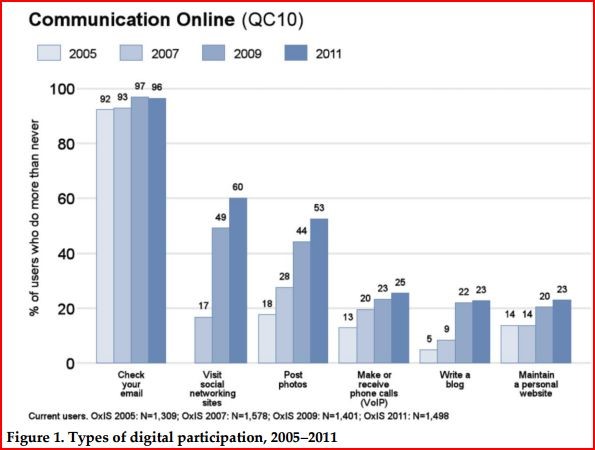
In a Report by Nic Newman about the Penetration of social networking in the UK derived from a survey by The Oxford Surveys, found that almost 60% of all internet users in the UK maintain a social networking profile in Facebook, twitter and other platforms as well (Newman, Mainstream media and the distribution of news in the age of social discovery, 2011).
Figure 1.2:
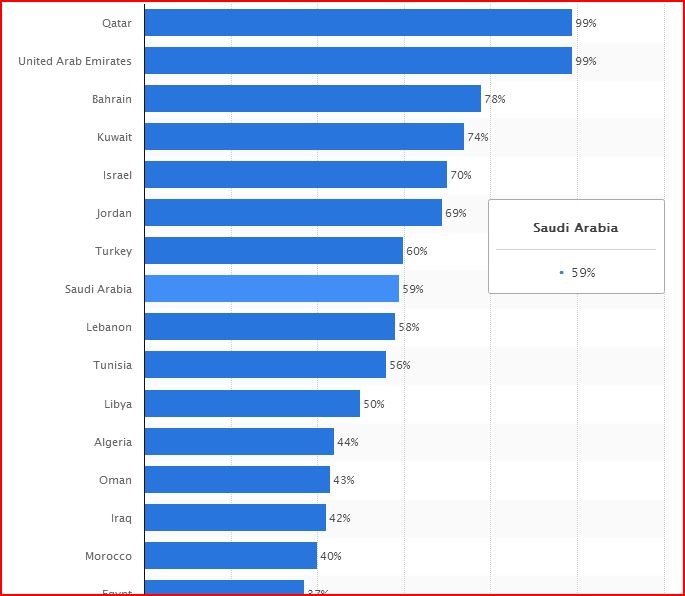
The MENA region has the highest penetration rate in the world when it comes to social media and internet with social media having the upper hand. The following statistics were a collective effort from 18,000 sources that were collected and published by Statista, the statistics portal (Statista, 2017).
Figure 3:
For functional effectiveness regarding the increase of literacy levels among audiences for different genres and classifications, there are many strategies that can be implemented. According to W. James Potter in His Book ‘Media Literacy’, there are three advantages that come from developing a higher media literacy which are (Potter, Nov 21, 2013, pp. 28,29):
- The appetite for wider and greater variety for media messages and content will grow. This will in turn lead to the freedom of opinion and choice of consumption levels by the person which makes it unpredictable for the source and harder to constrain the audience.
- Getting to know, understand and control the programming of your mental codes. Programming your mental codes to open you up to new experiences, as stated in Kashdan`s “Power of Curiosity” and also in The Self-determination theory regarding interest.
- You are able to control how you consume and perceive media.
- List of References
Baer, J. (n.d.). Convince and Convert. Retrieved from http://www.convinceandconvert.com/digital-marketing/why-the-future-of-marketing-is-curiosity-not-creation/: http://www.convinceandconvert.com/digital-marketing/why-the-future-of-marketing-is-curiosity-not-creation/
Forde, S. (Oct 2012, Vol. 18 Issue 2). Challenging the News: The Journalism of Alternative & Community Media. Pacific Journalism Review, 199-202.
Gilbert, E. (2015). The link between creativity and curiosity. (T. S. Us, Interviewer)
Hidi, K. A. ( 2016). the power of interest for motivation and engagement. In S. E. K. Ann Renninger, the power of interest for motivation and engagement (p. 68). 711 Third Avenue, New York, NY 10017: Routledge .
K Ann Renninger, S. H. (2014). The relation of interest to the motivation of behavior. In The Role of Interest in Learning and Development (pp. 60,61). New York: Psychology press, Taylor and Francis Group.
Kantar MillwardBrown. (2016). Generation Curious. Kantar MillwardBrown.
Kashdan, T. (2010). The Power of Curiosity. Experience life.
Livingstone, S. (2004). http://eprints.lse.ac.uk. What is media literacy?, 4. Retrieved from http://eprints.lse.ac.uk/1027/1/What_is_media_literacy_(LSERO).pdf.
Newman, N. (2009, 9). http://reutersinstitute.politics.ox.ac.uk. Retrieved from http://reutersinstitute.politics.ox.ac.uk/sites/default/files/The%20rise%20of%20social%20media%20and%20its%20impact%20on%20mainstream%20journalism_0.pdf
Newman, N. (2011). Mainstream media and the distribution of news in the age of social discovery. The Reuters Institute for the study of Journalism.
oxford. (n.d.). https://en.oxforddictionaries.com/definition/curiosity. Retrieved from https://en.oxforddictionaries.com/definition/curiosity.
oxford. (n.d.). https://en.oxforddictionaries.com/definition/curious. Retrieved from https://en.oxforddictionaries.com/definition/curious.
oxford. (n.d.). https://en.oxforddictionaries.com/definition/interest. Retrieved from https://en.oxforddictionaries.com/definition/interest.
Potter, W. J. (Nov 21, 2013). Media Literacy. SAGE Publications.
Statista. (2017). Retrieved from https://www.statista.com/statistics/309668/active-social-media-penetration-in-arab-countries/: https://www.statista.com/statistics/309668/active-social-media-penetration-in-arab-countries/
vicenzo marino, r. a. (2015). The lack of trust in mainstream media and the rise of social media as publishers. http://www.journalismfestival.com/news/the-lack-of-trust-in-mainstream-media-and-the-rise-of-social-media-as-publishers/.
Webster, J. G. (1997). The mass audience: Rediscovering the dominant model. Mahwah, NJ: Lawrence Erlbaum Associates.
http://www.ofcom.org.uk. (2016). Adult media use attitudes. Ofcom.org.uk.
- APPENDIX A: Interview Subjects
- George is a creative specialist at Nahtam Social Responsibility, Abu Dhabi UAE; Nahtam Social Responsibility creates ideas that make difference in society, encouraging government departments, corporate and public sector, media, social organizations and individuals to give back to the society. We focus on Education, Health, Environment, Art & Culture and Civic Issues. [www.nahtam.com]
- Basil H Saliba is The CEO and Creative Director of DonRite Consultancy and Design in Abu Dhabi UAE which is an Agency Dealing with Brand Creation, Creative advertising, Media Production and Event Management. [www.don-rite.net]
- AL Ittihad Newspaper officials have declined to give any information regarding Media literacy claiming confidentiality of its information.
- Some 5 others have ignored constant calls & e-mails with kind reminders for contribution but unfortunately in vain.
- APPENDIX B: Figures
- Figure 1.1 shows the three approaches to Interest Research derived from “The Role of Interest in Learning and Development”. By Ann Renninger, Suzanne Hidi, Andreas Krapp.
- Figure 1.2 is derived from The biannual Oxford internet surveys part of a Study to determine the media penetration in the UK.
- Figure 3 are Statistics of Social Media Penetration in Middle Eastern countries from collective sources assembled and published by Statista, The Statistics Portal and with the Help of Tableau which is a leading platform for statistics management.
- Interview questions
- What are the main skills needed to achieve the most basic literacy skills to understand media content?
- What is the focus mainly on in researching audience perceptions or reactions towards media content?
- In your opinion is curiosity and interest the same?
- How can you differentiate between them in a way that contributes to media literacy of a person?
- Would you relate behavioral psychology to media literacy? How?
- Is curiosity resistible? How?
- Is interest resistible? How?
 Marketing Communications Consultancy & Solutions